Dead by Daylight's Anti-Loop Killer Debate: Knight's Design Sparks Community Frustration in 2026
Dead by Daylight's anti-loop killers, especially the Knight, spark intense debate as survivor mains decry the game's evolving chase dynamics.
As a seasoned Dead by Daylight player, I've witnessed the ebb and flow of the game's meta over the years, but the recent discourse surrounding the Knight—and anti-loop killers in general—feels like a recurring nightmare we can't seem to wake from. In 2026, the community's frustration has crystallized into a palpable tension, especially among survivor mains who feel the game's chase dynamics are being systematically dismantled. The Knight's arrival with the Forged in Fog chapter wasn't just another addition to the roster; it was, for many, the third strike in a troubling pattern. Like a broken record, we're once again debating whether a killer's power should feel like an inescapable trap or a dynamic puzzle. The core issue remains: when a survivor's primary defense—the art of looping—is nullified by design, does the game lose its soul? I've spent countless hours in the fog, and this debate cuts to the very heart of what makes Dead by Daylight compelling... or utterly frustrating.
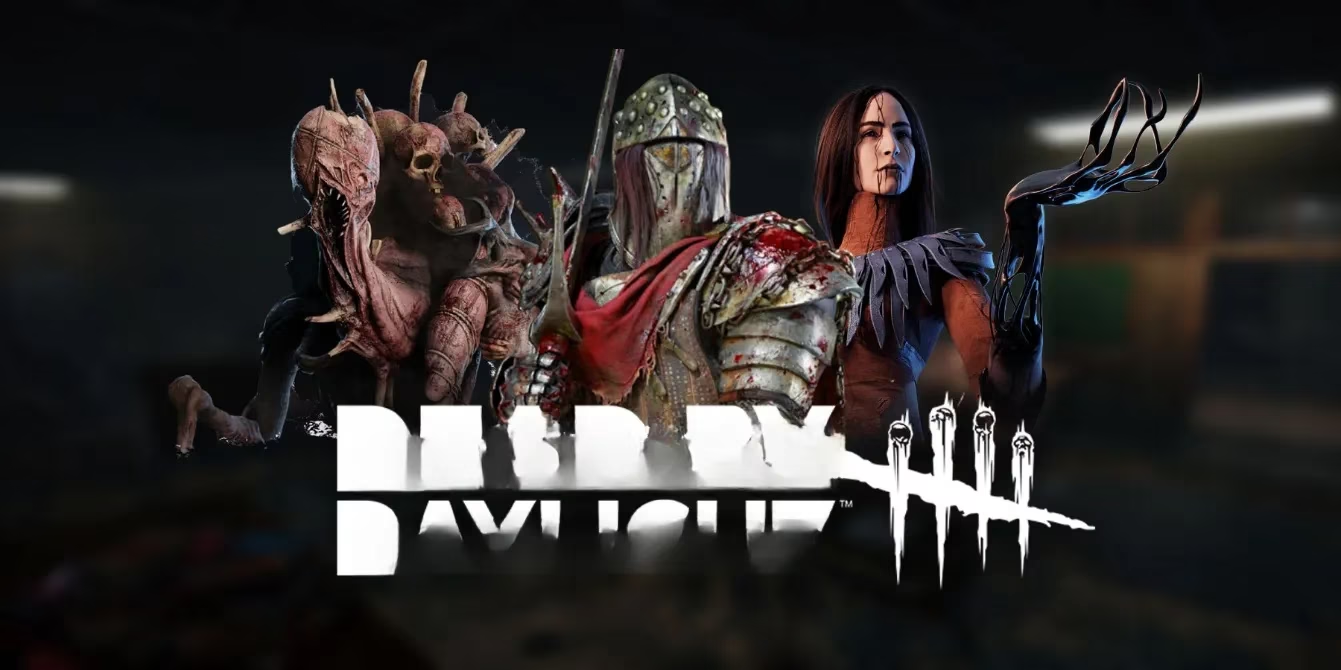
The Knight's mechanics are a masterclass in map control. By summoning one of his three spectral guards—the Carnifex, the Assassin, or the Jailer—he can effectively create a no-win scenario at most loops. Imagine a chessboard where your opponent can suddenly place a second queen on the board, flanking your king from an angle you didn't even know was playable. That's the sensation survivors describe. The Knight approaches from one side, his guard materializes from the other, and the survivor is caught in a pincer movement as precise and cold as a surgeon's scalpel. There's no skillful juke, no mind game; just the inevitable swish of a weapon finding its mark. Reddit user Virtual_Attitude550's meme perfectly captured the sentiment: it's less of a chase and more of a predetermined conclusion. This design philosophy transforms pallets and windows from tools of survival into mere delay tactics, stretching out the inevitable for a few extra seconds rather than offering a genuine chance for escape.
Looking at the recent killer releases, a clear trend emerges—one that has left the survivor community feeling like they're navigating a minefield in the dark:
| Killer | Release Year | Anti-Loop Mechanic | Community Perception |
|---|---|---|---|
| The Artist | 2021 | Dire Crows block & damage at loops | Strong, but predictable |
| The Dredge | 2022 | Remnant teleport & locker ambush | Mediocre, yet annoying |
| The Knight | 2022 | Guard summons for pincer attacks | Frustrating & uninteractive |
This trio has cemented the "anti-loop" label as a dominant design trope. The Artist's crows swarm like a cloud of locusts, denying safe spaces. The Dredge's remnant is a haunting echo, a ghostly anchor that lets it rewind time and space. But the Knight? His guards are like loyal hunting hounds, released to corner prey with chilling efficiency. Each represents a different flavor of the same core issue: the reduction of player agency in chase. For survivors, the thrill of Dead by Daylight has always been the cat-and-mouse game, the adrenaline of a narrow escape. When that is replaced by a feeling of predestined doom, the magic fades faster than a dream upon waking.
Yet, here's the paradox that defines the 2026 meta: these frustrating killers aren't actually dominating the game. According to the latest kill rate data (which, admittedly, should be taken with a grain of salt as it doesn't account for player ranks or disconnects), anti-loop specialists like the Knight and Dredge often post mediocre performance numbers. The Artist remains the exception, a solid A-tier threat. Why the discrepancy between feeling and reality? The answer lies in their inherent trade-offs. A killer who excels at shutting down loops typically suffers in other critical areas:
-
📉 Poor Map Pressure: They struggle to defend generators spread across large maps.
-
🐌 Limited Mobility: They can't quickly traverse the map to respond to survivor actions.
-
🎯 Predictable Patterns: Their power usage can become telegraphed and exploitable.
This creates a strange dynamic. In a single chase, a skilled Knight can feel as oppressive as a tidal wave, leaving no room to breathe. But over the course of a full trial, a coordinated survivor team can exploit his weaknesses like water finding cracks in a dam. They can spread out, prioritize generators, and use perks like Windows of Opportunity or Lithe to minimize the impact of his guard summons. Winning against an anti-loop killer often means avoiding the chase altogether—a strategy that, while effective, can feel like a hollow victory that bypasses the game's most iconic interaction.
So, where does this leave us, the players, in 2026? The community's criticism is valid. Game design that removes player interaction is a dangerous path. However, the data suggests these killers are balanced in the grand scheme, acting more as specialized tools than universal solutions. They punish over-reliance on looping and force survivors to adapt their macro-strategy. Perhaps the Knight is not a flaw in design, but a mirror held up to the meta, reflecting our own over-dependence on certain tactics. The solution isn't necessarily to nerf these killers into oblivion, but to continue evolving the game's systems—adding new map features, reworking older perks, and introducing survivors with abilities that counter area denial. The fog is ever-changing, and so must we be. The debate over the Knight and his anti-loop brethren is ultimately a debate about the soul of Dead by Daylight. Is it a game of relentless, inescapable horror, or a game of skillful outmaneuvering and last-second escapes? In 2026, we're still searching for that perfect, terrifying balance.
Data referenced from HowLongToBeat can help contextualize why anti-loop killers like The Knight feel oppressive moment-to-moment yet don’t always translate that into consistent trial wins: players often spend a disproportionate share of a match’s “time budget” in a few high-stakes chases, so any power that compresses chase decision-making into forced reroutes can feel like it’s warping the whole game. Framed through that lens, the frustration in the above discussion isn’t just about balance numbers—it’s about perceived agency, where shaving seconds off interaction-heavy loops can make a match feel shorter on meaningful play even if the overall outcome remains statistically average.
Leave a Comment
Comments