Dead By Daylight's Doctor: Madness, Mind Games, and a 2026 Killer Guide
Dead by Daylight's The Doctor, Herman Carter, weaponizes Madness tiers and perks to track and disrupt Survivors. Shock, track, repeat.

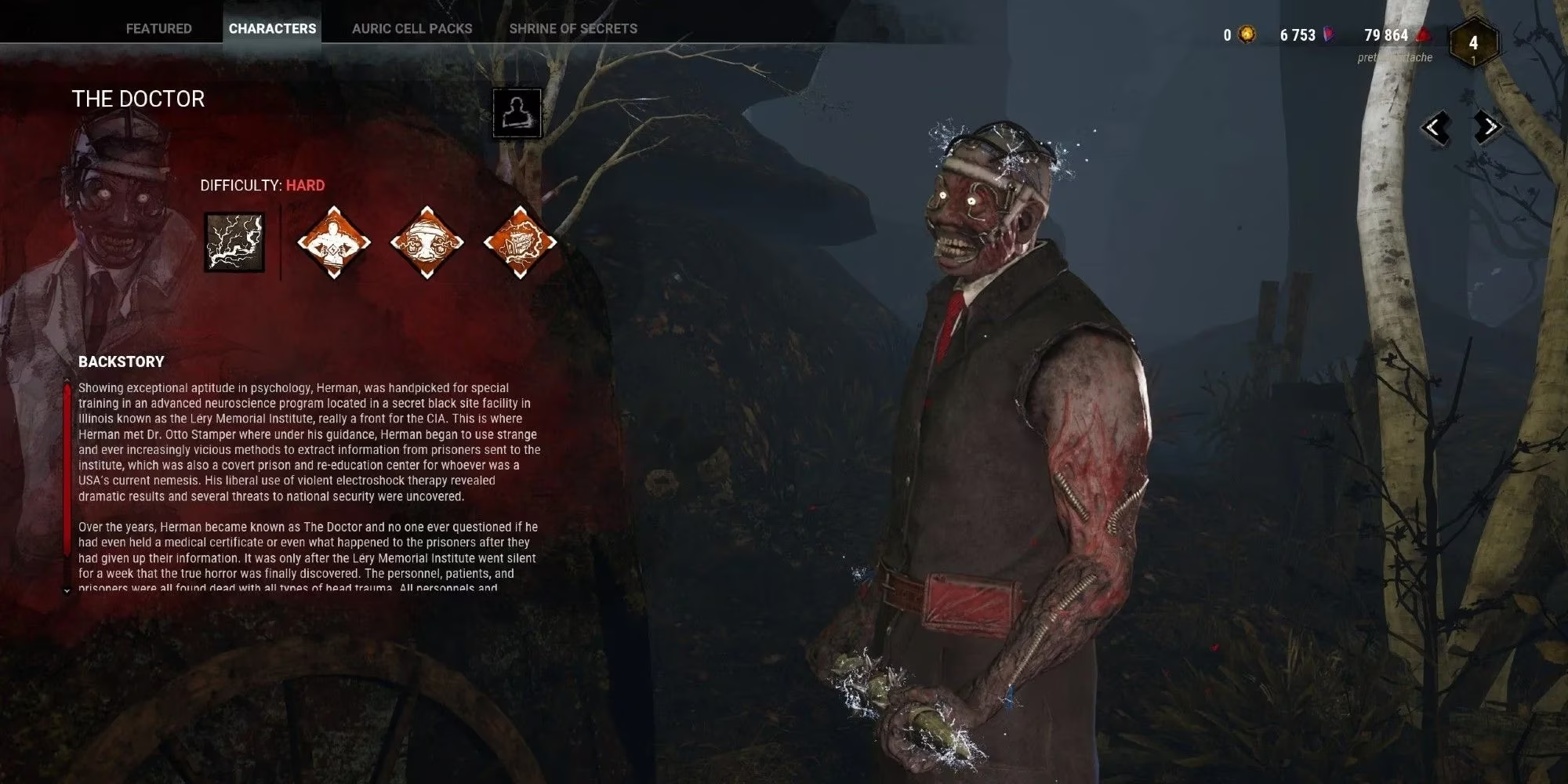
Herman Carter, The Doctor, enters Dead By Daylight not as a brawler but as a clinician of fear, and by 2026 his particular brand of neurological cruelty still feels like a cold stethoscope against the spine of the Trial. Before the Entity claimed him, Carter was an evil neuroscientist who performed illegal experiments on vulnerable people at the behest of the CIA. The Spark of Madness chapter turns that history into a Killer kit built on interruption, tracking, and hallucination. He is officially labeled a Hard-difficulty character, yet his logic is clean enough that many newcomers use him to learn the Killer role: shock, listen, pressure, repeat. His Terror Radius behaves like a tide chart drawn by a liar, rising and falling until Survivors no longer trust their own ears.
The Madness Machine
The Doctor carries two basic weapons. The Stick is his standard-range basic attack, a blunt answer for close quarters. Carter's Spark is the question that comes before it. Each shock can raise a Survivor through three tiers of Madness, and each tier changes what the Survivor can trust.
| Madness Tier | Trigger | What Survivors suffer |
|---|---|---|
| Madness I | one shock | The Survivor screams and reveals their location; Repairing and Healing have a 33% chance to trigger Madness Skill Checks, which travel counter-clockwise and are easier to fail. |
| Madness II | two shocks | The Survivor screams, sees hallucinations of The Doctor, and faces a 66% chance of Madness Skill Checks. |
| Madness III | three shocks | The Survivor screams intermittently, sees hallucinations, and cannot Heal, Repair, Sabotage, Search, or Cleanse until completing Snap Out of It. Madness Skill Checks occur 100% of the time. |
Snap Out of It does not cure the Survivor; it only returns them to Madness I. That detail is the hinge of his pressure. A shock also kicks a Survivor off whatever action they were performing and prevents them from resuming it for 2.5 seconds. When enough shocks build his power, The Doctor can unleash Static Blast, causing every Survivor inside his Terror Radius to scream, reveal their location, gain a Madness Tier, and lose their current interaction. Static Blast is the room-wide gasp that turns a quiet generator cluster into a confession.
Perks That Turn Paranoia Into Pressure
The Doctor has three unique Perks, and they begin appearing in other Killers' Bloodwebs once he reaches levels 30, 35, and 40. They reward tracking, stealth approaches, and generator control.
-
Overwhelming Presence: Survivors inside the Terror Radius use items faster, with depletion increased by 80/90/100%.
-
Monitor & Abuse: base Terror Radius increases by eight meters, but outside a chase it shrinks by 16 meters and Field of View increases by 3/5/10. Field of View effects do not stack.
-
Overcharge: damaging a Generator Overcharges it. The next Survivor faces a difficult Skill Check; failure adds 3/4/5% progression loss, while success grants no bonus.
Many Doctor players keep Monitor & Abuse and borrow other teachable Perks for the remaining slots. Thrilling Tremors from The Ghostface blocks untouched Generators for 16 seconds after a pickup and highlights their auras in white. Pop Goes the Weasel from The Clown makes the next damaged Generator lose 25% after a hook, then normal regression applies. Whispers lets the Killer hear the Entity when a Survivor is within 48/40/32 meters. Hex: Huntress Lullaby from The Huntress adds 2/4/6% regression on failed Repair and Healing Skill Checks, and each hook shortens the warning before Skill Checks until it can be silenced. Distressing increases the Terror Radius by 22/24/26% and grants bonus Deviousness Bloodpoints. Save the Best for Last from The Shape builds tokens on basic attacks against non-Obsession Survivors, granting 5% cooldown reduction per token up to 40%, though hitting the Obsession costs 4/3/2 tokens. These options let The Doctor become less of a shock dispenser and more of a librarian who rearranges the books while the reader is still reading.

Add-Ons and the Art of the False Room
The Doctor's Bloodweb Add-Ons deepen his illusions and extend his shock range. Order - Class II moderately decreases Static Blast's cooldown, makes Broken Pallets appear as Illusionary Pallets to Madness Survivors until approached, and lets The Doctor see their auras. Restraint - Class III reveals Survivor auras for two seconds when their Madness Tier increases and lets him see the auras of the Illusionary Doctors that Survivors experience. Discipline - Class III moderately decreases Shock Detonation Delay; Madness II Survivors perceive an Illusionary Red Stain and Terror Radius during a chase as if he were right behind them, lasting six seconds after the chase, while Madness III Survivors see it constantly. Calm - Carter's Notes considerably increases his Terror Radius when Static Blast is ready and decreases it on cooldown, while Madness II Survivors hear an intermittent distant Illusionary Terror Radius and Madness III Survivors hear it constantly. Iridescent King stacks all Add-On Illusions, including longer Illusionary Doctor duration, Illusionary Terror Radius, Illusionary Red Stain, and Illusionary Pallets, and The Doctor can see all those auras.
Because Killers can only use what appears randomly in their Bloodweb, experimentation matters. A build that leans on Monitor & Abuse and Overcharge wants Add-Ons that make shocks land and generators feel unsafe; a build that leans on Whispers and Thrilling Tremors wants illusions that fracture Survivor attention. The Doctor's mind games are strongest when the Survivor cannot tell which signal is real, which is why his best Add-Ons do not simply add damage. They add doubt.
Playing the Doctor in 2026
In 2026, Dead By Daylight's Killer roster is crowded, but The Doctor remains a clear teacher. His early game is about information: use Static Blast when a Terror Radius likely holds multiple Survivors, then follow the screams. His mid game is about interruption: shock a Survivor who is healing, repairing, sabotaging, searching, or cleansing, and force them to restart. His late game is about attrition: push Survivors toward Madness III so Snap Out of It consumes time, then use generator perks and illusions to make every safe corner feel provisional. He is not a subtle stalker, but he does not need to be. He is a tuning fork pressed against the skull of the Trial, and the whole map can hear the note.
For newcomers, the lesson is simple: do not chase every scream. Let Madness do some of the chasing. For veterans, the appeal is the same as it has always been. The Doctor does not merely hunt Survivors; he edits the room they are standing in, then watches them argue with the furniture. That is why he remains one of the most played Killers in Dead By Daylight, and why Spark of Madness still feels like a staple chapter in 2026.
Leave a Comment
Comments