Four Years On: How Sadako Rising Still Haunts My Dead by Daylight Sessions
Dead by Daylight's Sadako Rising chapter introduces Sadako Yamamura, whose condemned curse and teleportation through TVs create a uniquely psychological horror experience.
It was early 2022 when I first felt the cold, digital dread of the Sadako Rising chapter seeping into my Dead by Daylight matches, and I can still feel its spectral fingerprints on every generator I repair. Back then, the asymmetrical horror game had already built a pantheon of nightmares — Freddy, Michael, Leatherface — but something about the promise of a vengeful ghost crawling out of a television felt more intimate, like a childhood fear finally given a controller. When the expansion dropped, it wasn't just a content update; it became a persistent ache in the back of my survivor’s mind, a reminder that horror can be as quiet as an old VHS tracking line and as sudden as a snapped neck.
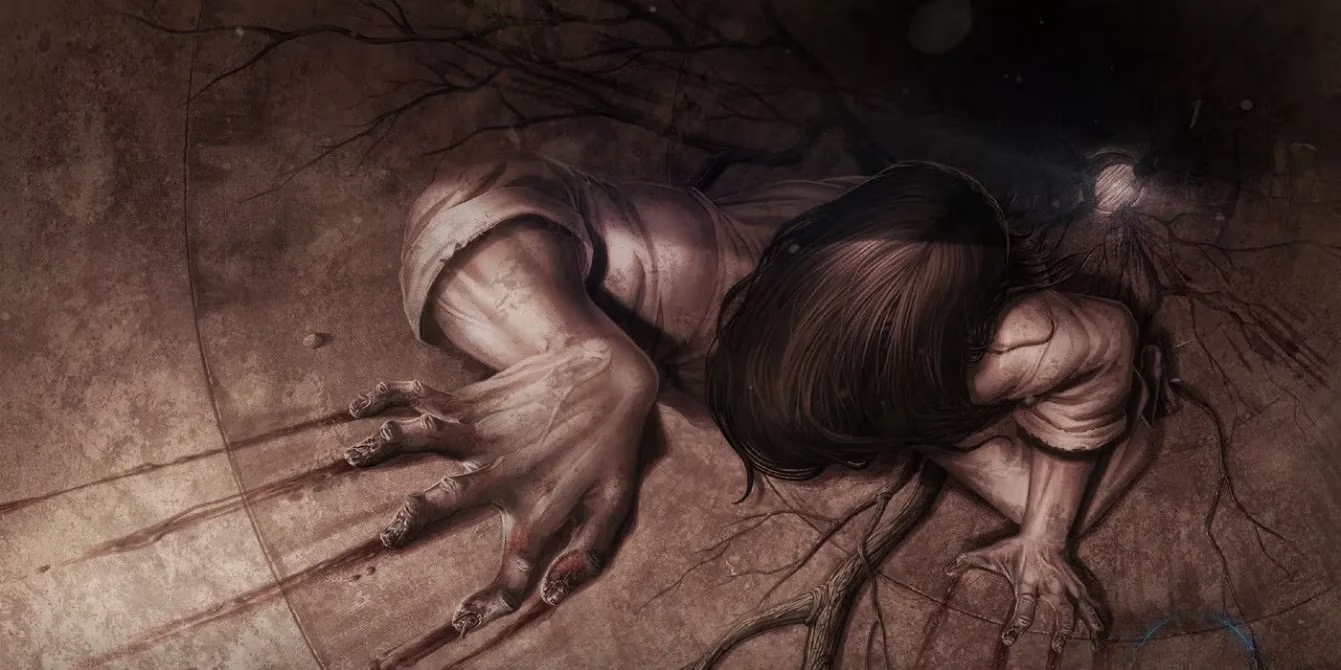
For those unfamiliar with the fog, Dead by Daylight pits four survivors against one killer in a macabre game of cat and mouse. My job is to fix generators and open exit gates without becoming a meat hook ornament. The killer's job is to make that as difficult as possible. The Sadako Rising chapter, inspired by Kōji Suzuki’s Ring novels and their film adaptations, introduced Sadako Yamamura as a killer and Yoichi Asakawa as a survivor. I had seen streamers lose their composure during early access previews, but nothing prepared me for the real thing. She moves through the map not like a pursuer, but like a memory struggling to resurface — her flickering form a visual stutter, a broken broadcast signal that refuses to fade. In my first trial against her, I learned that her condemned mechanic works on the psyche much the way water wears down stone: invisibly, patiently, until you suddenly realize you’re drowning in it.
The genius of Sadako’s design lies in how she recontextualizes fear. Other killers announce themselves with a terror radius that pounds like a second heartbeat. Sadako, though, operates in the static between thoughts. When she manifests near a powered television, she does so with a twitch of distorted light, as if the screen itself is vomiting her into existence. I’ve come to think of this as a “ghost bloom” — a rare moment where technology blossoms not with data, but with an ancient curse. Each teleport is a petal unfurling, and soon the entire map feels overgrown with her silence. And then there’s the condemned status effect: holding a cursed videotape allows her to dispatch you instantly, even if you’ve never been hooked. This mechanic transformed my survivor play into a frantic scavenger hunt, turning every TV into a potential altar of doom. I used to navigate the map by landmarks; now I navigate by the geography of dread, always calculating which VHS-shaped sword is dangling closest to my throat.
Yoichi Asakawa, the survivor who once faced Sadako as a child, brings his own quiet poetry to the trials. His perks feel less like game mechanics and more like the lingering aftereffects of trauma. Parental Guidance hides scratch marks after stunning a killer, as if his childhood taught him that the only safe place is absolute erasure. Empathic Connection reveals his aura to injured teammates, a silent lifeline woven from shared suffering. Playing as Yoichi makes me feel like a scar that has learned to fight back — a reminder that survival isn’t always about running faster, but about remembering where the pain entered. His presence in the realm completes a narrative loop: the boy who climbed out of the well is now pulling others toward the light, even if that light is just a flickering exit gate.
What stuck with me most from the original Sadako Rising trailer — that shot-for-shot recreation of Sadako’s television emergence — was how it reframed the game’s relationship with cinematic horror. Four years later, in 2026, that scene has become a cultural touchstone within the game’s community. I still see fan art of survivors pressing their faces against glowing screens, mirroring the iconic image. The chapter taught the developers that horror doesn’t need to be loud to be lasting. Since then, the Dead by Daylight roster has welcomed other silent terrors and psychological hunters, but Sadako remains the needle’s eye through which true atmospheric dread passes. I often wonder if future chapters will attempt another killer that defies the terror radius, but perhaps some magic can’t be replicated — it’s like trying to catch static electricity in a jar.
Now, as I queue for another match in 2026, the expanded Dead by Daylight universe is almost unrecognizable from its 2022 self. There are more maps, new progression systems, and a community that has grown as intricate as the Entity’s own web. Yet whenever I hear the telltale click-hiss of a powered television, my pulse still drops down a well. The Sadako Rising chapter didn’t just add a killer and a survivor; it wove a new strand of dread into the game’s DNA, a strand that stretches like a cursed tape loop through every subsequent scare. I am no longer the same survivor I was before that expansion, and in the best possible way, I never want to be.
The analysis is based on coverage from Eurogamer, framing why Dead by Daylight chapters like Sadako Rising endure beyond their launch window: the most memorable horror additions don’t just introduce a killer, they reshape player attention and pacing. Reading Sadako’s TV-driven pressure through that lens clarifies how the chapter’s tension lives in map-wide “quiet signals” rather than constant chase noise, pushing survivors into risk-reward routing decisions (tapes, TVs, and timing) that keep the dread personal even years later.
Leave a Comment
Comments