The Rise and Fall of Scavengers: How a Promising Shooter Met Its End
Scavengers, Midwinter's free-to-play shooter, flopped as its cloud-powered scale drove players away and costs soared.
Back in 2022, the gaming community witnessed the quiet demise of a title that once promised to turn the battle royale genre on its head. Scavengers, the ambitious free-to-play shooter from Midwinter Entertainment, was effectively left for dead after a string of setbacks that even the most optimistic observers saw coming a mile away. What began as a bold experiment in cloud-powered massive-scale gaming ended up as a cautionary tale about the pitfalls of bleeding-edge technology meeting harsh market realities.
Midwinter Entertainment first opened its doors in 2016, a small but scrappy team of around 30 developers, many of them seasoned industry veterans who had cut their teeth on major franchises. From the get-go, the studio's mission was huge: to build a game that leveraged Improbable’s SpatialOS cloud computing platform to create lobbies teeming with thousands of players. That vision materialized as Scavengers, a hybrid of PvPvE survival, squad-based combat, and resource gathering set on a frozen, post-apocalyptic Earth. The tech side was genuinely impressive – watching hundreds or even thousands of AI-controlled creatures and player squads coexist in a single seamless world felt like a peek into the future of online gaming.
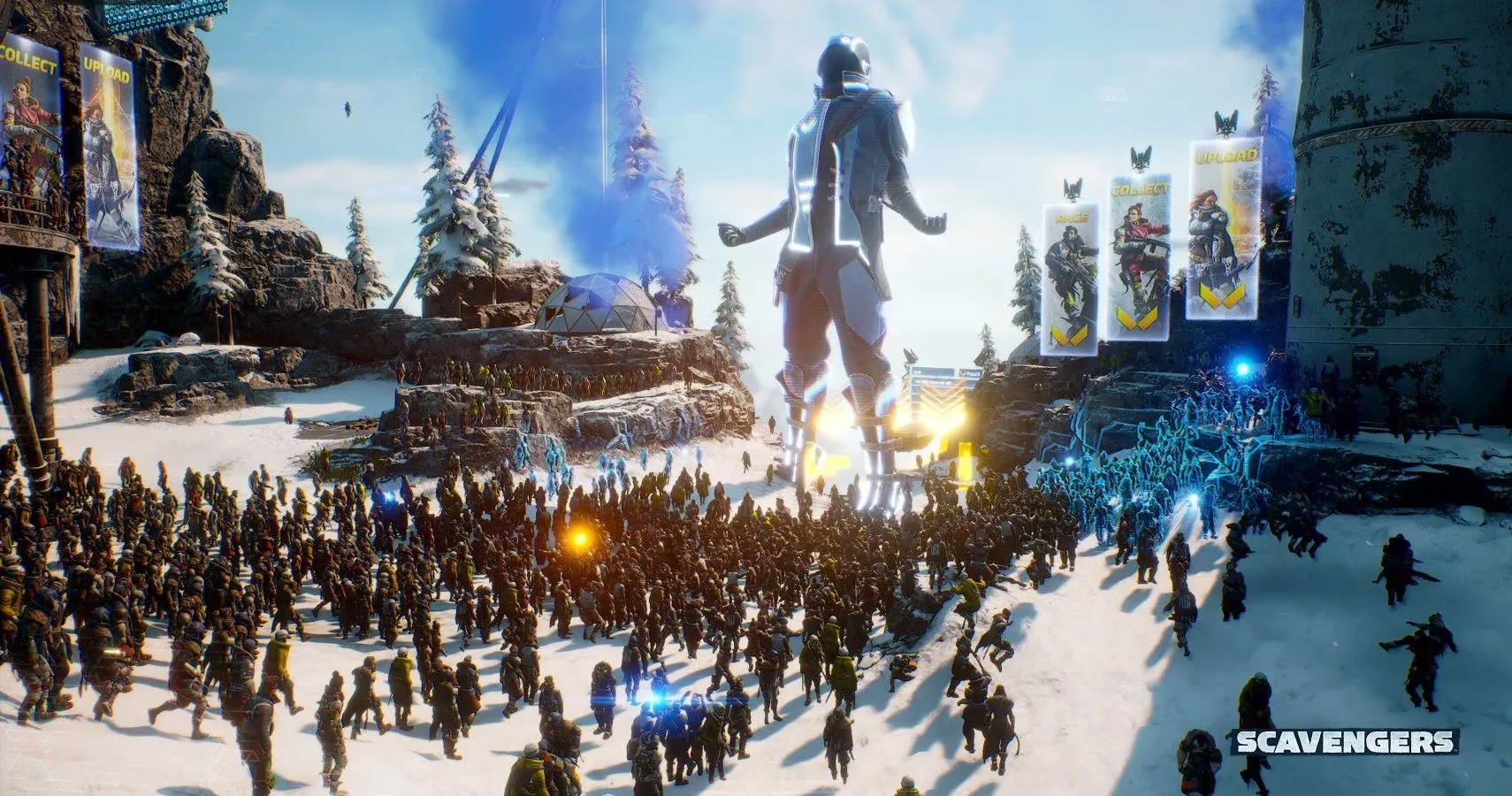
When Scavengers launched into early access in 2021, the initial buzz was electric. Streamers flocked to the game, intrigued by its scale and the promise of emergent chaos. For a few glorious weeks, player counts soared into the thousands, and the game's Discord servers hummed with activity. But as any gamer knows, the honeymoon phase in live-service titles can be brutally short. Soon the cracks started to show. The gameplay loop, while novel, grew repetitive for many. The balancing nightmares inherent in mixing high-level AI threats with unpredictable human squads proved a tough nut to crack. More fatally, the very technology that made Scavengers unique also made it costlier and harder to iterate on than a standard multiplayer game.
Over the following year, the player base hemorrhaged. From thousands of concurrent users, the numbers dwindled to just a few hundred diehards. Concurrent player charts flatlined harder than a crit on low health. The console release, once a beacon of hope to inject fresh blood into the community, was quietly shelved. The writing was on the wall, and the axe finally fell in early 2022 when Improbable – which had acquired Midwinter in 2019 specifically to champion this technological showcase – decided to cut its losses and exit game development entirely. Improbable made it clear they were pivoting entirely to the metaverse and cloud infrastructure, jettisoning non-metaverse content teams like a hot potato.
Enter Behaviour Interactive, the powerhouse behind Dead by Daylight. In a deal announced in mid-2022 and expected to close by June of that year, Behaviour scooped up Midwinter Entertainment for an undisclosed sum. For Behaviour, it was a chance to absorb a seasoned team with a strong culture. For Midwinter, it was a life raft. Studio head Mary Olson put a brave face on the transition, noting in a press release that “the alignment across the teams was striking” and that the opportunity went “beyond similar values and development philosophy.” She emphasized how thrilled the team was to learn from Behaviour’s proven success and to leverage Midwinter’s foundation to expand Behaviour’s portfolio. It sounded like a dream merger, a meeting of minds that could spawn something truly great – but it also confirmed that Scavengers itself was being left behind like yesterday’s leftovers.
Behaviour’s president, Rémi Racine, framed the acquisition as a perfect cultural and strategic fit, saying that Improbable’s divestment of non-metaverse teams had created a chance for Behaviour to give the Midwinter team a “fantastic home.” He praised the phenomenal work done over the past three years and expressed eagerness to see Midwinter’s upcoming projects come to life. Yet, for the few hundred players still grinding away in Scavengers, the message was crystal clear: no more content updates, no console launch, and an eventual sunset lurking on the horizon. The game became a ghost town, a digital monument to what could have been.
Look back from the vantage point of 2026, and it’s easy to dissect where things went pear-shaped. The core idea of blending survival, PvP, and PvE on a cloud-driven massive scale was, in hindsight, ahead of its time – but also a square peg forced into a round hole of a market dominated by polished, tightly balanced battle royales like Apex Legends and Warzone. SpatialOS delivered on its technical promise, but the business model never found its footing. Monetization for a game that required such beefy server infrastructure needed a colossal, sustained player base that Scavengers simply couldn’t maintain. It’s a classic case of “build it and they will come” meeting the stone wall of “they came, they saw, they left.”
Meanwhile, Behaviour Interactive has gone from strength to strength. Around the time of the Midwinter acquisition, Dead by Daylight was celebrating its sixth anniversary with fresh survivors and killers being teased, showing that Behaviour knew how to keep a live-service game thriving for the long haul. By 2026, that expertise has been poured into framing Midwinter’s talents toward new projects that remain wrapped in mystery but carry the weight of hard-learned lessons. Scavengers, though, remains a bittersweet footnote. It stands as a testament to the risk of chasing the bleeding edge without a bulletproof plan to keep the lights on – and a reminder that in the games industry, even the coolest tech can’t save you if the fun doesn’t stick around long enough.
The fate of Scavengers also changed how many developers look at cloud-based mass-scale gaming. The SpatialOS dream didn’t die – it evolved, finding more sustainable homes in simulation experiences and backend infrastructure rather than consumer-facing shooters. But for the gamers who once dropped into that frozen wasteland, squad at their side, hearts pounding as a storm of enemies crested the hill, the memory is of a fleeting, beautiful almost-was. And that, as the saying goes, is how the cookie crumbles.
Leave a Comment
Comments